
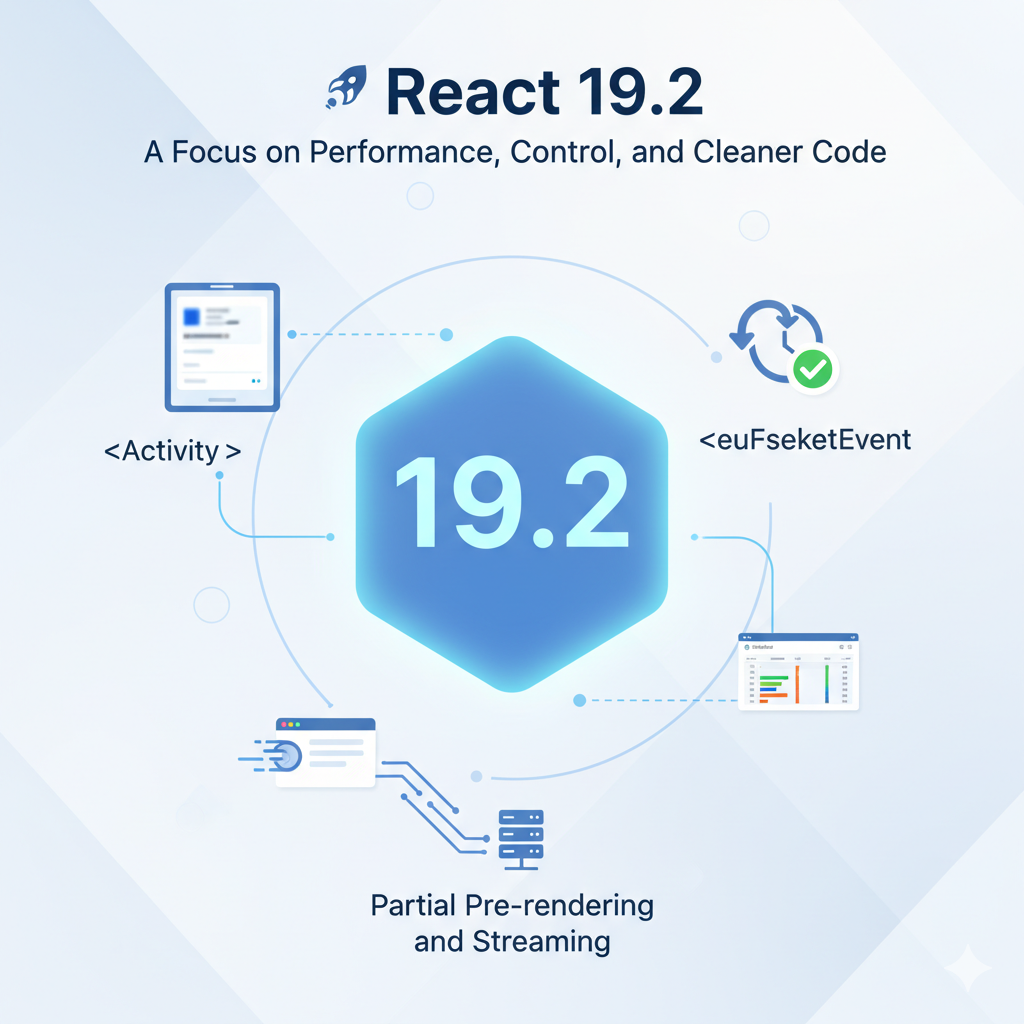

React v19.2, released in October 2025, is a significant refinement of the React 19 series, bringing major features out of experimentation and sharpening the tools that matter most for building fast, modern applications. This release focuses on giving developers more granular control over rendering, improving server-side rendering (SSR) workflows, and offering new primitives for cleaner, more predictable code.
Here’s a breakdown of the game-changing features you need to know about.
1. The <Activity /> Component: Smarter UI Visibility
The <Activity /> component is a powerful new tool that allows you to manage the visibility and resource consumption of different UI parts without relying on complex conditional rendering.
- The Problem it Solves: In multi-tab interfaces or complex dashboards, switching between views often involves completely unmounting the hidden content. While this saves memory, it means the entire component tree, state, and effects must re-run when the user switches back, leading to a noticeable lag.
- The Solution:
<Activity mode="hidden">- When set to
hidden, the component remains mounted, preserving its state (like form inputs or scroll position). - Crucially, its effects are unmounted, and its updates are deferred until React has idle time. This pauses unnecessary background work (like data polling) and prevents hidden content from fighting for resources with the visible UI.
- When set to
- The Benefit: Tab switching, back-navigation, and managing state in complex SPAs (Single-Page Applications) feel instantaneous because the component is already “warmed up.”
2. useEffectEvent: Solving the Effect Dependency Problem
The useEffectEvent hook is a new primitive that tackles one of the most common pitfalls in React development: the stale closure problem and the “dependency churn” that leads to unnecessary re-runs.
- The Problem it Solves: Often, you need an effect (like a subscription listener or an analytics tracker) to run once on mount, but its callback function needs to access the latest state or props. Developers were forced to either include that state in the dependency array (causing the effect to re-run constantly) or use messy
useRefworkarounds. - The Solution:
$const onEvent = useEffectEvent(() => { /* event logic */ });$- This creates a stable function reference (
onEvent) that always sees the latest props and state, just like a regular event handler. - The best part? It should not be included in your
useEffectdependency array, and the ESLint linter will enforce this.
- This creates a stable function reference (
This leads to cleaner, more expressive effects that run exactly when you intend them to, without the risk of infinite loops or re-subscriptions.
3. Partial Pre-rendering (PPR) and Streaming Enhancements 🌐
React 19.2 makes major strides in the Server-Side Rendering (SSR) and Streaming story, enabling incredibly fast initial page loads.
- Partial Pre-rendering (PPR): This new workflow allows your build process (often via a framework like Next.js) to pre-render a static HTML shell (the “Prelude”) that can be instantly served from a CDN. The dynamic parts of the page are rendered later and seamlessly streamed in using new
resumeAPIs. This dramatically improves Core Web Vitals (like LCP) and perceived performance. - Batched Suspense Boundaries: A behavioral inconsistency between client-side rendering and streaming SSR has been fixed. During streaming, Suspense boundaries are now batched briefly, allowing multiple fallbacks to resolve and reveal content together. This prevents the “janky” cascade effect and aligns SSR behavior with client-side transitions.
- Node Web Streams Support: New server-side rendering APIs like
renderToReadableStreamandprerendernow have built-in support for Web Streams in Node.js environments, modernizing the streaming architecture for better cross-platform compatibility.
4. Performance Tracks for Chrome DevTools 🔍
Debugging and profiling are now significantly better with the deep integration of Performance Tracks directly into Chrome DevTools.
- Scheduler Track: Provides a clear visual timeline of React’s internal work prioritization. You can distinguish between high-priority “blocking” work (like user input) and lower-priority “transition” work (like background state updates).
- Components Track: Gives a hierarchical view of component processing, showing when components are rendering, re-rendering, or executing effects, helping you pinpoint performance bottlenecks instantly.
These tools make it much easier to understand why your app is slow and to validate that features like startTransition and <Activity /> are working as intended.
In Conclusion
React 19.2 is a refinement release that solidifies the vision of the React 19 era: cleaner code, smarter rendering, and superior performance. The new primitives like <Activity /> and useEffectEvent reward developers who write disciplined, declarative code, while the SSR enhancements ensure that applications are fast by default.
It’s time to update your projects and take advantage of a more powerful, predictable, and performant React ecosystem!
