
Introduction
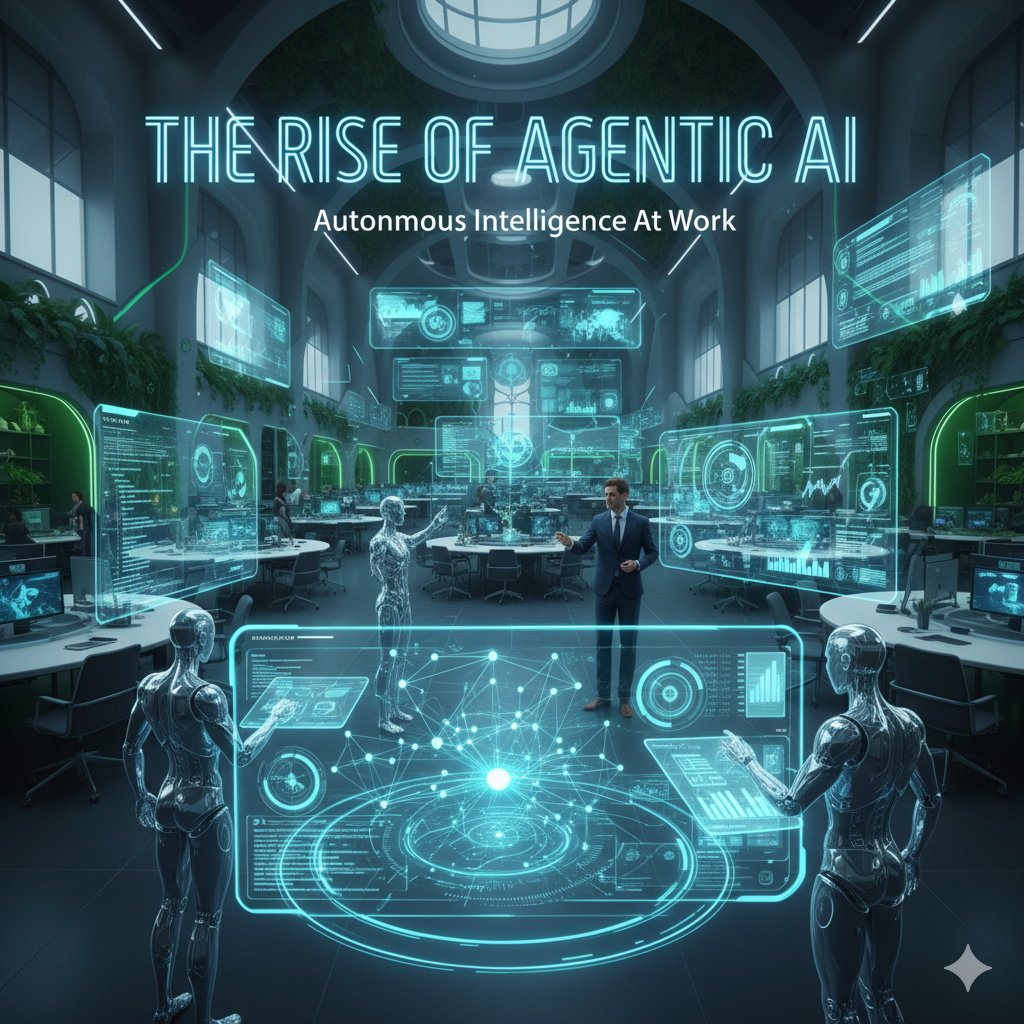
Artificial intelligence has evolved dramatically over the past decade. We’ve moved from narrow, task-specific models to large language models capable of reasoning across domains. Yet, the next frontier is neither scale nor capability alone—it’s agency: the ability for AI systems to autonomously perceive their environment, make decisions, and take actions toward defined goals.
Agentic AI represents a fundamental shift in how we build intelligent systems. Instead of responding passively to queries, agentic AI systems actively pursue objectives, adapt to changing circumstances, and operate with minimal human intervention. This isn’t science fiction; it’s becoming the operational reality for forward-thinking organizations.
What Is Agentic AI?
At its core, agentic AI refers to autonomous systems capable of:
- Perception: Understanding their environment through data, APIs, or sensors
- Planning: Breaking down high-level goals into actionable steps
- Execution: Taking independent actions in the real world or digital systems
- Adaptation: Learning from outcomes and adjusting strategies
- Autonomy: Operating with minimal human supervision for extended periods
A simple example: A customer service AI isn’t agentic if it merely suggests responses to a human operator. It becomes agentic when it autonomously resolves tickets, escalates complex cases, pulls information from databases, and notifies customers—all without human intervention.
Agentic AI vs. Traditional AI
| Aspect | Traditional AI | Agentic AI |
|---|---|---|
| Interaction Model | Reactive (responds to queries) | Proactive (pursues goals) |
| Decision-Making | Single-step or linear | Multi-step with feedback loops |
| Tool Use | Limited or pre-defined | Dynamic access to multiple tools |
| Autonomy Level | Low (requires constant input) | High (operates independently) |
| Adaptability | Fixed behavior | Learns and adjusts in real-time |
| Scope | Narrow, specific tasks | Complex, multi-domain workflows |
Key Characteristics of Agentic AI
1. Goal-Oriented Architecture
Agentic systems operate with explicit objectives. Rather than processing isolated requests, they maintain context around what they’re trying to achieve and continuously work toward it. This goal-orientation enables complex reasoning and long-horizon planning.
2. Tool and Integration Ecosystem
True agentic AI doesn’t live in isolation. It integrates with:
- APIs and databases (retrieving and updating information)
- RPA tools (automating repetitive tasks)
- Domain-specific systems (CRMs, ERPs, analytics platforms)
- External services (payment processors, communication platforms)
This ecosystem turns the AI from a passive insight engine into an active participant in business operations.
3. Reasoning and Planning
Agentic systems employ sophisticated reasoning approaches:
- Chain-of-thought decomposition (breaking problems into steps)
- Retrieval-augmented generation (pulling relevant context before responding)
- Reflection and error-correction (evaluating outcomes and adjusting)
- Multi-turn reasoning (iterating through complex problems)
4. Safety and Guardrails
With autonomy comes responsibility. Robust agentic systems include:
- Permission boundaries (what the agent can and cannot do)
- Approval workflows (human-in-the-loop for critical decisions)
- Audit trails (complete logging of all agent actions)
- Fallback mechanisms (graceful degradation when uncertain)
Real-World Applications
Enterprise Automation
- HR Operations: Agents autonomously process leave requests, update payroll systems, and coordinate onboarding workflows
- Finance: Automated expense management, invoice reconciliation, and financial forecasting
- Procurement: Agents identify cost savings, manage RFQ processes, and vendor negotiations
Customer Engagement
- Support Automation: Resolve issues end-to-end, including account updates and refunds
- Personalization Engines: Autonomously tailor product recommendations and communications in real-time
- Loyalty Programs: Manage reward points, identify redemption opportunities, and engage customers proactively
Research and Development
- Data Analysis: Agents autonomously explore datasets, generate hypotheses, and recommend analyses
- Experiment Design: Autonomous systems propose and conduct A/B tests, optimizing product features
- Literature Review: Synthesize research papers and identify emerging trends without manual curation
Software Development
- Autonomous Code Review: Agents analyze pull requests, identify bugs, suggest optimizations
- Continuous Integration: Monitor deployments, detect anomalies, and trigger rollbacks or escalations
- Technical Debt Management: Autonomously refactor legacy code and update dependencies
Building Agentic AI Systems
Core Components
- The Brain (Large Language Model)
- Foundation model handling reasoning and decision-making
- Fine-tuned for domain-specific knowledge
- Sensory Input
- APIs for data ingestion
- Real-time event streams
- User queries and context
- Action Engine
- Orchestration layer managing tool calls
- Execution environment with permissions
- State management across long horizons
- Memory and Learning
- Short-term context windows
- Long-term vector databases for retrieval
- Feedback loops for continuous improvement
Design Patterns
Loop-Based Execution:
Observe → Reason → Plan → Act → Evaluate → Repeat
Tool-Use Pattern: The agent decides what tool to use, invokes it with parameters, observes the result, and proceeds.
Hierarchical Agents: Complex systems decompose goals into sub-agents, each specialized for specific tasks.
Challenges and Considerations
Technical Challenges
- Hallucination and Errors
- AI systems may confidently state false information
- Mitigation: Grounding in verified data sources, verification loops
- Context Limitations
- LLMs have finite context windows
- Mitigation: Strategic summarization, vector databases for efficient retrieval
- Tool Integration Complexity
- Managing permissions, API latency, and error handling across disparate systems
- Mitigation: Robust orchestration layers, graceful degradation
- Determinism vs. Creativity
- Balancing reproducible, predictable behavior with adaptive decision-making
- Mitigation: Configurable temperature, explicit decision thresholds
Organizational Challenges
- Change Management
- Teams must adapt to AI-driven workflows
- Resistance from employees fearing automation
- Solution: Clear communication, retraining, role redefinition
- Accountability and Governance
- Who is responsible when an agent makes a mistake?
- How do we audit AI decisions?
- Solution: Clear policies, comprehensive logging, human-in-the-loop for critical decisions
- Data Privacy and Security
- Agents accessing sensitive data across systems
- Risk of data leakage or misuse
- Solution: Strict access controls, encryption, compliance audits
The Future of Agentic AI
Near-Term (1-2 Years)
- Agentic systems become standard in enterprise automation
- Specialized agents for vertical industries (healthcare, finance, legal)
- Improved reasoning capabilities and tool ecosystems
Medium-Term (2-5 Years)
- Multi-agent systems collaborating on complex problems
- Increasingly autonomous scientific research and discovery
- Regulatory frameworks and standards for agentic AI
Long-Term (5+ Years)
- Autonomous software development and infrastructure management
- Agentic AI participating in strategic business decisions
- Emergence of new economic models around agent labor
Getting Started
Organizations interested in agentic AI should:
- Start Small: Pilot projects in high-impact, lower-risk areas
- Build Infrastructure: Invest in robust APIs, logging, and monitoring
- Iterate Fast: Treat agent development like product development—rapid experimentation
- Focus on Integration: Connect agents to existing systems incrementally
- Plan for Governance: Establish guardrails, approval workflows, and audit practices before deploying autonomous systems
Conclusion
Agentic AI represents the next evolution of artificial intelligence. By moving from passive insight engines to active autonomous agents, organizations can dramatically increase efficiency, reduce costs, and unlock new capabilities.
The technology is real today. Companies are deploying agentic systems to automate workflows, improve customer experience, and accelerate innovation. The question is no longer if agentic AI will transform business, but when—and whether your organization will lead or follow.
The future belongs to organizations that understand agentic AI, invest wisely in its development, and navigate its challenges with thoughtfulness and care. The autonomous intelligence era has arrived.